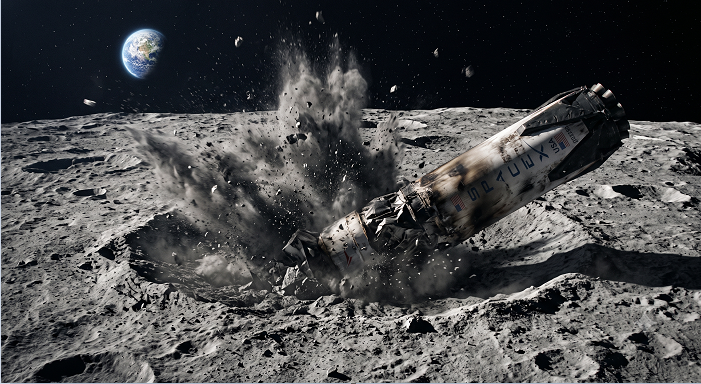
In an event that sounds like a plot from a science fiction novel, a four-tonne piece of a SpaceX rocket, roughly the size of a school bus, has unintentionally crashed into the Moon. The discarded Falcon 9 rocket stage is believed to have struck the lunar surface near the Einstein Crater at approximately 06:35 GMT on Wednesday, August 5, 2026 .
The impact, which was confirmed by the European Southern Observatory, was not a controlled maneuver but the result of a drifting piece of space junk caught in a celestial game of gravitational pinball .
The Journey from Launch to Lunar Impact
The object was the second stage of a SpaceX Falcon 9 rocket that was launched in January 2025 from NASA’s Kennedy Space Center in Florida . Its primary mission was to deploy Firefly Aerospace's Blue Ghost 1 lunar lander on its journey to the Moon .
Usually, after a rocket completes its mission, this second stage is commanded to perform a de-orbit burn, causing it to re-enter Earth's atmosphere where it burns up or falls into the ocean . However, this particular mission was different; it required more thrust to send the lunar lander on its way, leaving the upper stage in a high, chaotic orbit around Earth . With its fuel depleted and no way to control its path, the booster became an aimless piece of space debris.
For 18 months, the rocket stage drifted, until earlier this year, astronomers realized it was on a collision course with the Moon . "What has happened is essentially a mixture of solar activity and gravity forces have put it on a path towards the Moon," explained Julianna Scheiman, SpaceX director of NASA science and Dragon programmes .
A Powerful Impact with Scientific Value
The collision was not insignificant. Traveling at a speed of 5,400 miles per hour (8,690 km/h), the impact released kinetic energy equivalent to about three tonnes of TNT . This powerful smash is estimated to have carved out a crater about 18 meters (60 feet) wide and 3.7 meters (12 feet) deep .
While the event was unintentional, it provided a unique scientific opportunity. Space scientists were eager to observe the resulting plume of lunar dust and debris . "It might be possible for folks with a telescope to observe the plume of ejecta created by the impact," said Benjamin Fernando of Los Alamos National Laboratory, lead author of a study on the anticipated impact .
NASA's Lunar Reconnaissance Orbiter and South Korea's Pathfinder Lunar Orbiter are expected to capture high-resolution images of the new crater, which could provide insights into the Moon's geology and how ejecta plumes behave .
A Growing Issue of Space Debris
This incident is a stark reminder of the growing challenge of space debris, not just in Earth's orbit but also in cislunar space—the region between Earth and the Moon . While a natural meteoroid with similar energy strikes the Moon roughly every six days, artificial impacts are far less common .
It marks only the second known time a piece of human-made space junk has accidentally hit the Moon; the first was a Chinese rocket stage in March 2022 . As astronomer Bill Gray, who tracked the object, noted, "It doesn't present any danger to anyone, though it does highlight a certain carelessness about how leftover space hardware is disposed of" .
The event has renewed discussions about debris mitigation strategies. With NASA planning to establish a sustained human presence on the Moon through its Artemis program, the risk of errant space junk crashing into lunar assets is a concern that space agencies and companies like SpaceX are actively discussing