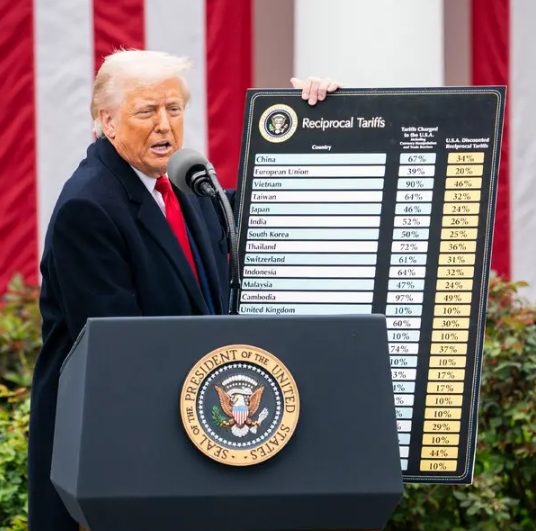
Washington, D.C. – The Trump administration has rolled out a new wave of global tariffs, imposing duties of 10% to 12.5% on imported goods from over 60 trading partners. The new levies took effect on July 24, 2026, at 12:01 a.m. Eastern Time, closing a 150-day gap created by a Supreme Court ruling that struck down the president's earlier tariff authority .
From 10% to 15% and Back Again
The tariff saga began in February 2026 when the Supreme Court ruled 6-3 that the president's use of the International Emergency Economic Powers Act (IEEPA) to impose sweeping tariffs was illegal. Chief Justice John Roberts wrote that the president must "point to clear congressional authorization" for actions of such "vast economic and political significance" .
Hours after the ruling, an infuriated President Trump signed an executive order imposing a 10% global tariff under Section 122 of the Trade Act of 1974, which allows such taxes for up to 150 days without congressional approval . The following day, he threatened to raise the rate to 15%, declaring on social media that he would "determine and issue the new and legally permissible Tariffs" .
That threat, however, did not materialize immediately. The 10% tariff remained in place until its statutory expiration on July 24, 2026 .
The New Two-Tier System
The administration's latest action, announced on July 23, 2026, uses Section 301 of the Trade Act of 1974—a more legally durable mechanism that allows the president to impose tariffs on countries found to engage in trade practices deemed "unjustifiable, unreasonable, or discriminatory" .
The new tariff structure operates on a two-tier basis :
10% Tariff: Applied to economies that have either imposed a forced labor import prohibition, committed to enforcing such a prohibition through a trade agreement, or adopted a partial regime to prevent forced labor imports. This group includes Canada, Mexico, the European Union, the United Kingdom, Argentina, India (lowered from the originally proposed 12.5%), and Indonesia .
12.5% Tariff: Applied to countries deemed to have failed to address forced labor practices adequately. This group includes China, Japan, South Korea, Brazil, Switzerland, Australia, and Nigeria .
According to U.S. Trade Representative Jamieson Greer, the tariffs are justified by international labor standards. "The United States has had a forced labor import ban for nearly a century, and rigorously enforces it; it's well past time for our trading partners to do the same," Greer stated . The administration argues that the tariffs will "correct what is both a human rights abuse and distortive trade practice" .
Exemptions and Economic Impact
The administration has carved out significant exemptions from the new tariffs :
-
Oil, gas, and fertilizer
-
Beef, tomatoes, bananas, coffee, and orange juice
-
Products already covered by Section 232 national security duties (automobiles, steel, aluminum, copper)
-
Goods qualifying for duty-free status under the United States-Mexico-Canada Agreement
The tariffs cover 99% of U.S. imports and affect the top 60 U.S. trade partners . They do not stack on top of existing steel and aluminum tariffs, which remain under separate legal authority .
Business Community Warns of Higher Costs
The proposed tariffs drew sharp criticism from U.S. businesses and trade groups during the public comment period. By the July 6 deadline, the USTR had received at least 980 submissions, many warning that additional tariffs would disrupt supply chains and increase costs .
"Layering additional tariffs on products that are already subject to existing trade measures can create unnecessary cost burdens and supply chain complexity for US manufacturers," said Eve Duchene, an executive assistant at Modules Technology in San Jose, California .
Economists echoed these concerns. Tom Fullerton, an economist at the University of Texas at El Paso, warned that "lower income US consumers will face the biggest consequences from the new tariff hikes" because they purchase more merchandise goods, many of which are produced in China or contain Chinese components .
Legal and Political Challenges Ahead
While Section 301 is considered more legally robust than IEEPA, the new tariffs may still face court challenges. Trade lawyers have noted that Section 301 grants the president broad authority to impose tariffs after investigation, but some critics have questioned whether the forced labor investigation was sufficiently detailed .
The timing of the tariffs—less than four months before the November midterm elections—carries political risk for the Trump administration and Republicans, with Democrats focusing on rising living costs . A Washington Post/ABC News/Ipsos poll found that 64% of Americans disapprove of how Trump handles tariffs, while only 34% approve .
International Response
Trading partners have responded with caution. The European Union froze approval of a trade agreement with the U.S. pending clarity on the tariff situation, and India postponed trade negotiations . China, through the China Association of Automobile Manufacturers, stated that "Chinese law fully prohibits forced labor" and warned that tariffs "will only raise costs for US importers and consumers" .