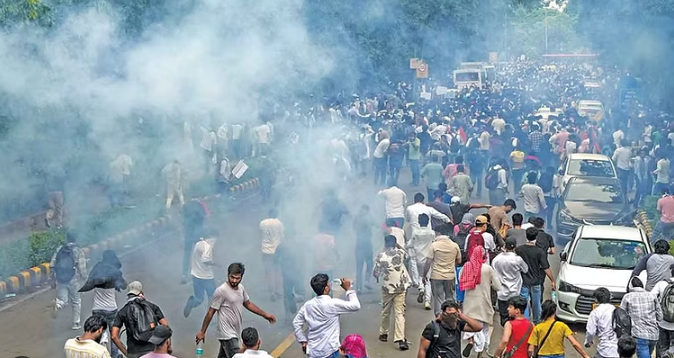
The sweltering summer heat of Delhi has become a secondary concern for thousands of students who have turned the historic grounds of Jantar Mantar into a battlefield. Their weapon is not violence, but a unified voice demanding accountability. Their cause? The integrity of their medical careers, jeopardized by recurring leaks in the National Eligibility-cum-Entrance Test (NEET).
The protests, which have seen a significant escalation with the involvement of activist Sonam Wangchuk, represent a breaking point for India’s medical aspirants. What began as a reaction to a specific paper leak has transformed into a broader, more profound movement against systemic apathy towards youth and education.
The "Cockroach" Movement
The protests are organized under the banner of a unique political entity: the Cockroach Janta Party (CJP). This satirical political movement, founded in May 2026, emerged from the ashes of a controversial remark by a Supreme Court judge who compared unemployed youth to "cockroaches" . The movement has since gained massive momentum among young people who feel similarly dehumanized by a system that seems to treat their futures lightly.
The Trigger: A Scandal of Massive Proportions
The immediate cause of the protest was the cancellation of the NEET-UG 2026 results. Held on May 3 for approximately 2.3 million students, the exam was compromised when question papers were leaked on platforms like Telegram and WhatsApp well before the test . In an unprecedented move, the government canceled the results and ordered a re-test, a decision that, while intended to ensure fairness, disheartened millions who had spent years preparing .
Protesters argue that this is not an isolated incident. Paper leaks have become a recurring nightmare, shattering the dreams of countless students . The emotional and psychological toll is devastating. Activists claim that as many as 22 disillusioned students committed suicide following this year’s leak alone, reflecting the immense pressure these young people face .
A Unified Demand
At Jantar Mantar, the demands are clear and unwavering. Protesters are calling for the resignation of Union Education Minister Dharmendra Pradhan, holding him accountable for the repeated failures in exam security . "Formal student associations often focus on a narrow set of issues," one observer noted, "but social media and protests like these fill the void to address a multitude of grievances" .
The movement has drawn a diverse crowd, including students, parents, and professionals, many of whom are participating in a public demonstration for the first time . They speak not only about paper leaks but also about the crushing cost of coaching, the stress of the exam, and the fear of a compromised future where merit no longer guarantees success. Critics warn that when the system is perceived as corrupt, it erodes "the trust and cohesion that holds society together" .
A Glimpse of Solidarity and Resistance
On July 20, the protests reached a dramatic peak when thousands marched towards Parliament. The demonstration was met with police force, including tear gas and baton charges, resulting in injuries and detentions . However, the spirit of resistance remains undeterred. The movement draws strength from the legacy of non-violent protest in India, echoing the traditions of Mahatma Gandhi .
For the medical aspirants at Jantar Mantar, this fight is about more than just one exam. It is a fight for their right to a fair chance, for the recognition of their sacrifice, and for a future where a doctor's merit is determined by their knowledge, not their access to a leaked paper. As the protests continue, the nation watches, waiting to see if the voice of the youth will finally be heard.