For supply chain leaders, a small disruption can quickly become a major operational problem. A delayed shipment can create a raw material shortage, disrupt production schedules, increase expedited freight costs, and ultimately affect customer commitments.
This is why businesses are moving beyond reactive supply chain management. By combining enterprise resource planning (ERP) with AI capabilities such as Microsoft Copilot, organizations can identify potential issues earlier, evaluate alternatives, and make faster, more informed decisions.
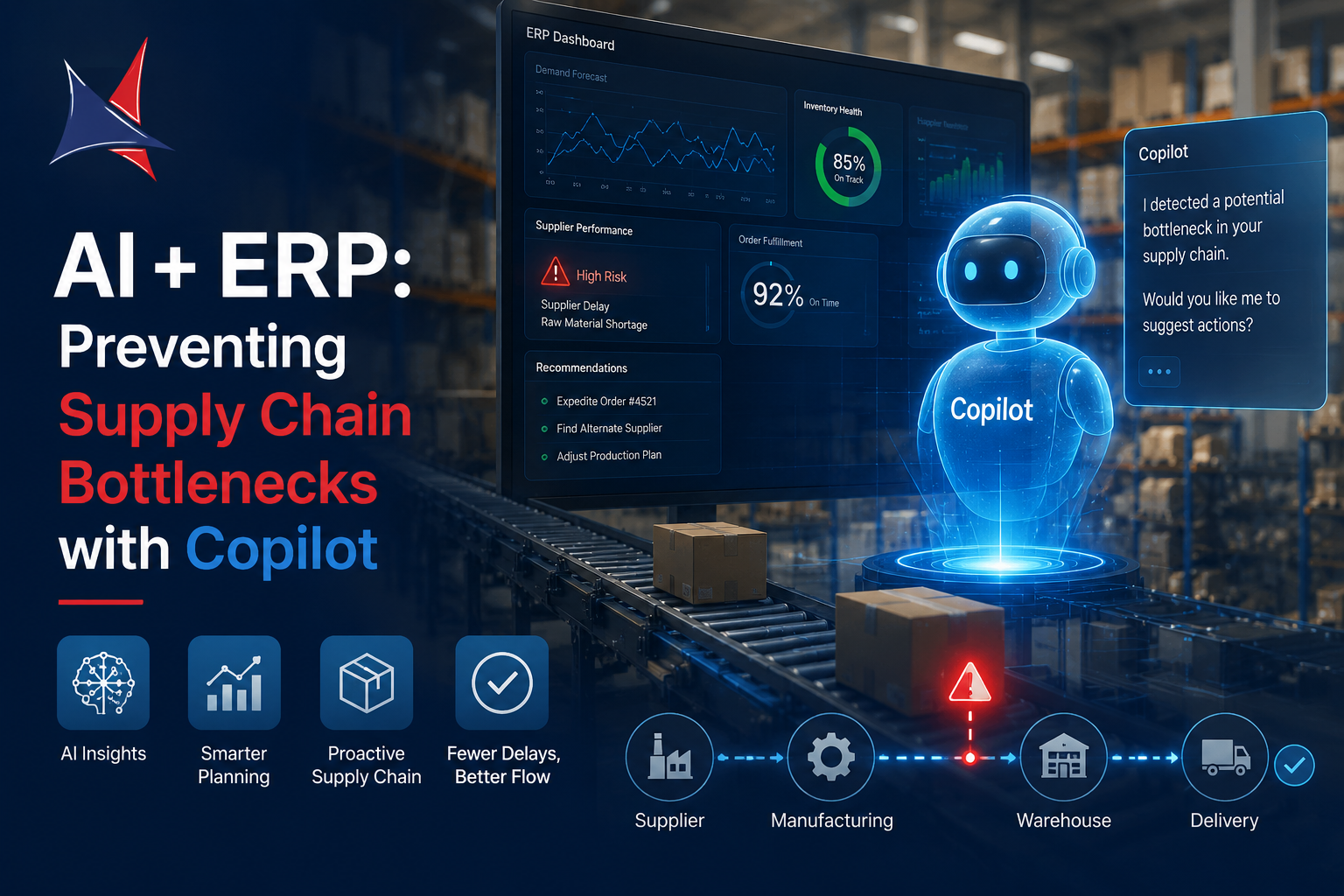
Traditional Supply Chain: Disruption → Manual Investigation → Delayed Response → Production Impact
AI-Enabled Supply Chain: Early Warning → AI Analysis → Recommended Action → Proactive Resolution
Microsoft Copilot within Dynamics 365 Supply Chain Management can help organizations improve planning, supplier collaboration, inventory management, warehouse operations, and asset maintenance. When implemented strategically, these capabilities can help businesses build a more responsive and resilient supply chain.
Why Traditional Supply Chain Planning Falls Short
Traditional ERP systems are highly effective at recording transactions and managing operational processes. However, supply chain teams often need more than historical data to make decisions.
Planners may spend hours reviewing purchase orders, inventory reports, supplier emails, demand forecasts, and production schedules. When these sources are disconnected, identifying the relationship between a supplier delay and a potential production shortage can become a manual process.
This can lead to several challenges:
- Excessive safety stock to compensate for uncertainty
- Higher expedited shipping costs
- Limited visibility into supplier risks
- Delayed responses to demand changes
- Communication gaps between procurement, production, and warehouse teams
- Difficulty identifying problems before they affect customers
AI can help bridge this visibility gap by analyzing information faster and presenting actionable insights within existing workflows.
AI-Powered Demand Planning
Accurate demand forecasting is one of the foundations of an efficient supply chain.
Traditional forecasting methods often depend heavily on historical sales patterns. While historical data remains valuable, it does not always reflect changing customer behavior, promotions, market conditions, or other factors that can influence demand.
AI-enabled planning can analyze multiple data signals and identify patterns that may not be immediately obvious to planners. Instead of manually reviewing large datasets and testing forecasting approaches, supply chain professionals can use AI-assisted insights to understand changing demand and adjust purchasing or production plans accordingly.
For example, if demand for a particular product begins increasing in a specific region, an AI-enabled system can help planners recognize the trend earlier. Procurement teams can then evaluate inventory requirements and supplier capacity before the increase becomes a stockout problem.
The result is a shift from simply reacting to historical demand toward continuously adapting to changing business conditions.
Proactive Supplier Risk Management
Supplier delays are among the most common causes of supply chain disruption.
A four-day delay in a critical component may appear manageable at first. However, if that component is required for multiple production orders, the downstream impact can be much greater.
Dynamics 365 Supply Chain Management can help organizations improve visibility into purchase orders, supplier commitments, inventory requirements, and production dependencies. With Copilot capabilities, users can interact with supply chain information more naturally and quickly identify relevant details.
Consider a supplier that changes the delivery date for a critical purchase order. Instead of manually reviewing multiple planning screens, a buyer can use AI-assisted insights to understand the potential consequences of the change.
The system may help answer questions such as:
- Which production orders could be affected?
- When could inventory become insufficient?
- Which customer orders are at risk?
- Are alternative materials available?
- Could production be rescheduled?
- Is inventory available at another facility?
With this information available earlier, procurement and production teams can evaluate alternatives before the shortage reaches the factory floor.
Smarter Inventory Management
Having sufficient inventory does not always mean having inventory in the right location.
For organizations operating multiple warehouses or distribution centers, inventory can become unevenly distributed. One facility may have excess stock while another is approaching a stockout.
AI-assisted analytics can help supply chain teams identify these patterns and make better inventory allocation decisions.
For example, if sales velocity for a product begins increasing in one region, the business can evaluate whether inventory should be repositioned from another warehouse. This can help reduce stockout risk while avoiding unnecessary inventory purchases.
AI can also support warehouse teams by providing operational insights into workloads, picking activities, replenishment requirements, and other warehouse processes.
The goal is not simply to automate warehouse operations. It is to give supervisors and workers better information so they can prioritize the activities that have the greatest operational impact.
Optimizing Warehouse Operations
Warehouse bottlenecks can occur when demand suddenly increases or when workloads are not distributed efficiently.
Picking, putaway, replenishment, receiving, and shipping activities all compete for warehouse capacity. Without clear visibility, supervisors may spend significant time determining which tasks should receive priority.
AI-generated insights can help summarize warehouse activity and highlight areas that require attention.
For example, warehouse teams can use operational data to identify:
- Open picking work
- Pending replenishment activities
- Receiving workloads
- High-priority orders
- Warehouse capacity constraints
- Active operational workloads
By improving visibility, AI can help warehouse managers make faster decisions and keep fulfillment activities moving.
Predictive Maintenance for Manufacturing
For manufacturers, equipment downtime can create some of the most expensive supply chain disruptions.
A machine failure on a critical production line can delay manufacturing, create labor inefficiencies, disrupt customer deliveries, and require emergency maintenance.
Predictive maintenance changes the traditional approach.
Reactive maintenance: Repair equipment after failure.
Preventive maintenance: Service equipment according to a fixed schedule.
Predictive maintenance: Use equipment data and detected conditions to determine when maintenance may be required.
When Dynamics 365 Supply Chain Management is integrated with relevant IoT and operational data, manufacturers can gain greater visibility into equipment conditions.
Sensors can monitor factors such as temperature, vibration, operating cycles, and other equipment indicators. When unusual patterns are detected, maintenance teams can investigate potential issues before they become major failures.
This approach can help organizations coordinate maintenance with production schedules, check spare-parts availability, and reduce unexpected downtime.
Turning AI Insights Into Supply Chain Action
AI is most valuable when insights can be converted into practical business decisions.
Simply generating a forecast or identifying an anomaly is not enough. Supply chain teams need workflows that allow them to respond quickly.
An effective AI-enabled supply chain connects:
Data → Insight → Recommendation → Human Decision → Business Action
For example, a supplier delay can trigger an impact assessment. That assessment can identify affected production orders, inventory levels, and customer commitments. A planner can then evaluate alternative production schedules or sourcing options.
This creates a more proactive decision-making process while keeping human expertise at the center of critical operational decisions.
The Role of a Microsoft Solutions Partner
Implementing AI capabilities within an ERP environment requires more than enabling software features. Organizations must consider their existing processes, data quality, integrations, security requirements, user adoption, and long-term objectives.
This is where an experienced implementation partner can add value.
Cambay Solutions helps organizations modernize Microsoft business applications and implement solutions designed around their operational requirements. As a Microsoft Solutions Partner, the company works with businesses to simplify complex technology environments and connect Microsoft technologies with practical business outcomes.
Its expertise across Dynamics 365, Microsoft Azure, Microsoft 365, and AI solutions can help organizations develop a technology strategy that supports more efficient and resilient operations.
Learn more about Cambay Solutions and its Microsoft business technology services.
Building a More Resilient Supply Chain
Supply chain management is becoming increasingly data-driven. Businesses can no longer rely solely on historical reports and manual processes to respond to rapidly changing demand, supplier conditions, and operational constraints.
Microsoft Copilot and Dynamics 365 Supply Chain Management offer organizations opportunities to bring AI-assisted insights into everyday planning and operational workflows.
From demand forecasting and supplier risk analysis to inventory optimization, warehouse management, and predictive maintenance, AI can help businesses identify potential bottlenecks earlier and respond with greater speed.
The future of supply chain management is not about replacing experienced planners and operations teams. It is about giving them better information, faster analysis, and intelligent assistance so they can make stronger decisions.
For organizations looking to move from reactive supply chain management toward proactive, AI-enabled operations, combining Dynamics 365 Supply Chain Management with the right AI strategy can be an important step toward greater resilience, efficiency, and long-term growth.