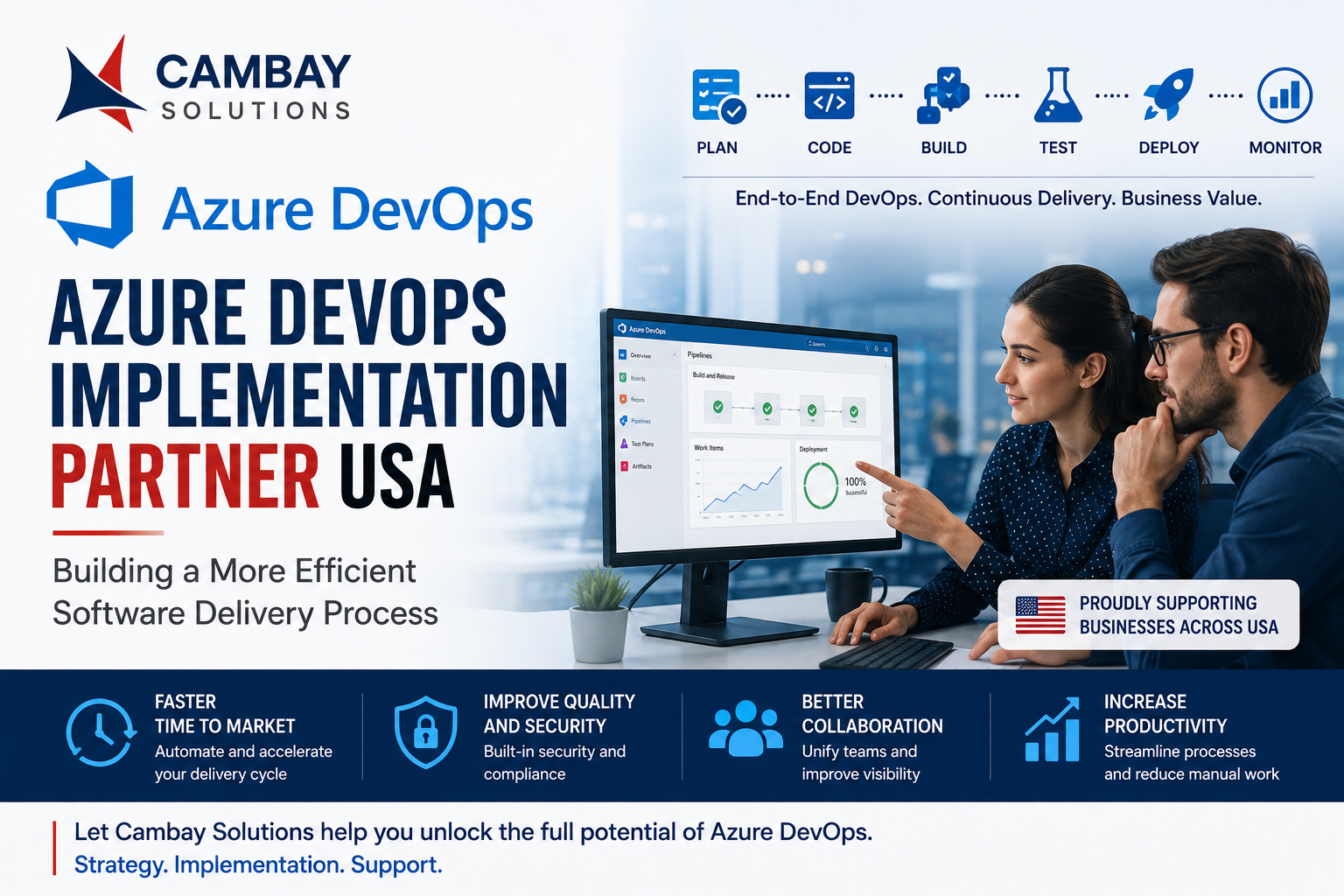
Modern businesses need to develop, test, and release applications faster while maintaining quality, security, and reliability. As development environments become more complex, organizations need tools and processes that help development and operations teams work together efficiently.
This is where an Azure DevOps implementation partner in USA can make a significant difference.
Azure DevOps provides a collection of services that support software development, project management, version control, testing, and continuous delivery. However, implementing these capabilities effectively requires careful planning and configuration.
What Is Azure DevOps?
Azure DevOps is a Microsoft platform designed to support software development and delivery.
It provides capabilities for planning projects, managing source code, tracking work, building applications, testing software, and deploying applications.
Organizations can use Azure DevOps to create a more structured development lifecycle and improve collaboration between development, operations, testing, and business teams.
Why Businesses Need an Azure DevOps Implementation Partner
Simply subscribing to Azure DevOps does not automatically create an efficient DevOps environment.
Organizations need to determine how projects should be structured, how teams should collaborate, how code should be managed, and how applications should move from development to production.
An Azure DevOps implementation partner USA can help businesses design and implement these processes according to their specific requirements.
A professional partner can help organizations avoid common implementation problems and create a DevOps environment that can scale as development needs grow.
Key Azure DevOps Implementation Services
Azure DevOps Strategy and Planning
Implementation should begin with understanding the organization's development environment and business objectives.
A consulting partner can evaluate existing tools, workflows, applications, and development practices before creating an Azure DevOps implementation roadmap.
Azure Repos Implementation
Azure Repos provides version control capabilities that allow development teams to manage source code effectively.
A partner can help configure repositories, branching strategies, permissions, and collaboration processes to support organized development.
Azure Pipelines Implementation
Continuous integration and continuous delivery are important components of modern software development.
Azure Pipelines can automate application builds, testing, and deployments.
A properly designed pipeline can reduce manual processes and create a more consistent path from code development to application deployment.
Azure Boards Implementation
Azure Boards helps teams plan and track development work.
Organizations can use boards, backlogs, work items, and other planning capabilities to improve project visibility.
An implementation partner can help configure workflows and project structures around the organization's development methodology.
Testing and Quality Management
Software quality is an important part of DevOps.
Azure DevOps can support automated and structured testing processes as part of the development lifecycle.
A consultant can help integrate testing into development and deployment workflows to identify issues earlier.
Benefits of Working With an Azure DevOps Partner
Faster Software Delivery
Automation can reduce manual development and deployment activities, helping teams deliver software more efficiently.
Better Collaboration
Azure DevOps brings planning, development, testing, and deployment activities into a connected environment.
This can improve communication between teams and provide greater visibility into project progress.
Improved Deployment Consistency
Automated pipelines can help standardize application builds and deployments, reducing the risks associated with manual processes.
Greater Visibility
Development managers and business stakeholders can gain better visibility into work items, development progress, testing, and releases.
Scalable DevOps Practices
As organizations grow, their development processes often become more complicated.
A well-designed Azure DevOps environment can provide a foundation for scaling teams, projects, applications, and deployment processes.
How to Choose an Azure DevOps Implementation Partner in the USA
Choosing the right implementation partner can have a significant impact on the success of a DevOps initiative.
Businesses should look for a partner with experience in Azure DevOps, cloud technologies, software development, automation, CI/CD, testing, and application modernization.
It is also important to consider whether the partner understands the organization's existing development environment.
A good implementation partner should focus on business requirements rather than applying the same DevOps configuration to every organization.
Azure DevOps Implementation for Different Business Needs
Every organization has different development requirements.
A startup may need a simple DevOps environment that supports rapid application development.
A growing enterprise may require advanced CI/CD pipelines, multiple development teams, security controls, automated testing, and integration with existing systems.
An organization modernizing legacy applications may require Azure DevOps as part of a broader application modernization strategy.
The implementation should therefore be designed around the organization's applications, teams, workflows, and long-term objectives.
Cambay Solutions as an Azure DevOps Implementation Partner
Cambay Solutions helps businesses with technology modernization, cloud solutions, application development, and digital transformation initiatives.
For organizations searching for an Azure DevOps implementation partner in the USA, Cambay Solutions can support DevOps-related initiatives by helping businesses evaluate their development environment, improve workflows, implement automation, and modernize software delivery practices.
A structured approach can help organizations build more efficient development processes while supporting scalability, collaboration, and continuous improvement.
Whether a business is adopting Azure DevOps for the first time or looking to improve an existing DevOps environment, professional implementation guidance can help create a more effective development lifecycle.
Frequently Asked Questions
What does an Azure DevOps implementation partner do?
An Azure DevOps implementation partner helps businesses plan, configure, implement, and optimize Azure DevOps services according to their development and business requirements.
Why should businesses use an Azure DevOps implementation partner?
A partner can provide expertise in DevOps strategy, CI/CD, source control, testing, automation, project management, and Azure technologies, helping organizations avoid implementation challenges.
Can Azure DevOps automate deployments?
Yes. Azure Pipelines can support automated build, testing, and deployment processes, helping organizations establish consistent software delivery workflows.
Is Azure DevOps suitable for small businesses?
Yes. Azure DevOps can be used by organizations of different sizes. The implementation can be scaled according to the number of teams, applications, and development requirements.
Can Azure DevOps support legacy application modernization?
Yes. Azure DevOps can be incorporated into application modernization initiatives to improve development workflows, testing, automation, and deployment processes.
How does Cambay Solutions help with Azure DevOps?
Cambay Solutions can help businesses evaluate their DevOps requirements and support technology modernization, application development, automation, and Azure-related initiatives.
Conclusion
Software development is becoming increasingly dependent on automation, collaboration, and efficient delivery processes. Azure DevOps provides businesses with tools to manage development activities from planning and coding to testing and deployment.
However, successful implementation requires more than simply enabling the platform.
An experienced Azure DevOps implementation partner USA can help organizations develop appropriate workflows, automate processes, improve collaboration, and create a scalable DevOps environment.
With the right implementation strategy, businesses can build a more efficient software delivery lifecycle while creating a strong foundation for future application and cloud modernization.