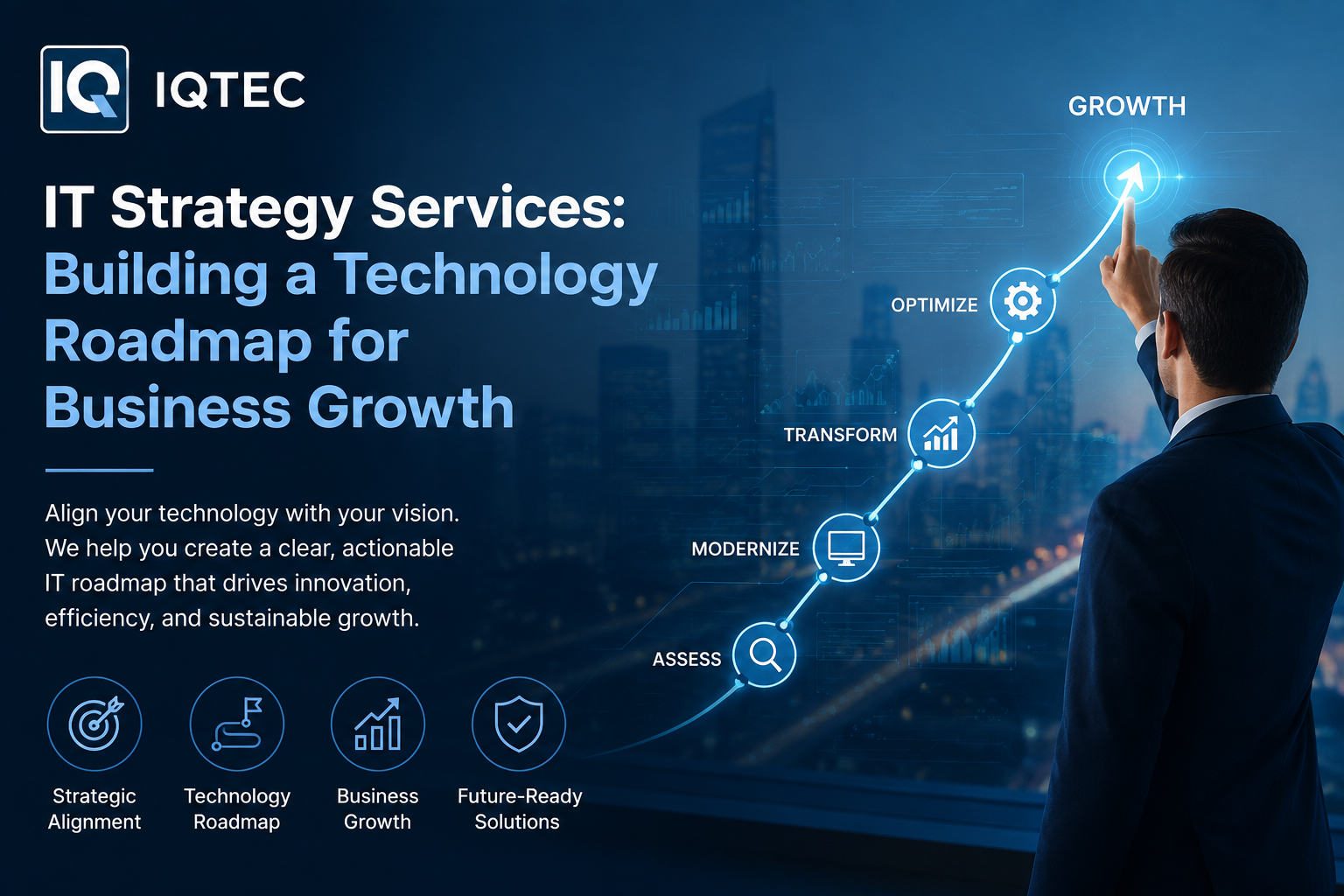
Technology should do more than keep your business running. The right IT environment can improve productivity, support growth, strengthen security, reduce unnecessary costs, and create new opportunities. However, without a clear direction, businesses can end up investing in technologies that don't align with their actual needs.
IT strategy services help organizations connect technology decisions with business objectives. Rather than treating IT as a collection of separate systems, an IT strategy creates a structured roadmap for how technology should support the organization today and in the future.
What Are IT Strategy Services?
IT strategy services involve assessing an organization's current technology environment and developing a plan for improving it in line with business goals.
The strategy may cover infrastructure, cloud adoption, cybersecurity, applications, data, user experience, IT spending, governance, and future technology investments.
Instead of asking simply, "What technology should we buy?", an effective IT strategy asks:
"What does the business need to achieve, and how can technology help us get there?"
This shift helps organizations make more informed and purposeful technology decisions.
Why Does a Business Need an IT Strategy?
Technology decisions made without a long-term plan can create unnecessary complexity. Businesses may end up with overlapping applications, outdated infrastructure, security weaknesses, or increasing IT costs.
A defined strategy provides a framework for making technology decisions based on priorities rather than reacting to problems as they appear.
1. Align Technology With Business Objectives
IT should support measurable business outcomes. Whether the goal is expansion, improved customer service, operational efficiency, or workforce productivity, technology investments should contribute to those objectives.
2. Plan Future Technology Investments
An IT strategy can help businesses determine which technologies require investment, which systems should be upgraded, and which solutions may no longer provide sufficient value.
3. Improve IT Spending
Rather than investing in technology simply because it is new or popular, businesses can assess the actual value, cost, and business impact of proposed solutions.
4. Reduce Technology Risks
A strategic review can uncover areas such as outdated systems, weak security controls, unsupported software, or infrastructure limitations before they become larger problems.
What Does an IT Strategy Include?
There isn't a single template that works for every organization. A useful strategy is built around the company's objectives and technology environment.
Current-State Assessment
The process begins by understanding what the business currently has. This can include infrastructure, applications, cloud platforms, cybersecurity controls, connectivity, devices, and IT processes.
Future-State Vision
The next step is defining where the organization wants its technology environment to be. This creates a target that future IT investments can work toward.
Technology Roadmap
The roadmap converts the strategy into actionable initiatives. Projects can be organized according to urgency, business value, complexity, and available resources.
Cybersecurity Planning
Security should be integrated into the broader IT strategy rather than treated as a separate consideration. This may include identity management, endpoint protection, data security, backup, compliance, and risk management.
Cloud Strategy
Businesses need to determine where cloud technology provides genuine value and how cloud services should be implemented, managed, and secured.
Budget Planning
A strategic IT plan can help organizations forecast technology costs and prioritize spending over short- and long-term periods.
Signs Your Business May Need an IT Strategy
Your organization may benefit from an IT strategy if:
- IT decisions are mostly reactive.
- Technology costs are difficult to predict.
- Different teams use disconnected applications.
- Existing systems are becoming outdated.
- Cybersecurity concerns are increasing.
- The business is preparing for rapid growth.
- Cloud adoption is happening without a clear plan.
- Management isn't sure which technology investments should come first.
From Technology Problems to Business Priorities
A good strategy doesn't attempt to fix everything simultaneously.
For example, a growing business might discover that its immediate priority is improving identity and security controls. Once those foundations are addressed, the next phase might focus on cloud modernization and automation.
This prioritization prevents businesses from spreading their resources across too many projects at once.
A practical IT roadmap can therefore be structured around:
Now → Next → Later
Now: Critical risks and immediate operational improvements
Next: Projects that improve efficiency and scalability
Later: Strategic initiatives and emerging technology opportunities
IT Strategy vs. IT Planning
These terms are related but not identical.
IT planning generally focuses on specific technology activities, projects, budgets, and timelines.
IT strategy takes a broader view. It establishes why particular technology decisions should be made and how they contribute to the organization's long-term direction.
Planning becomes much more effective when it is guided by a clear strategy.
How iQtec Can Help With IT Strategy
iQtec helps Australian businesses develop practical approaches to technology, consulting, cybersecurity, cloud, and IT management.
Its IT strategy approach can help organizations evaluate their existing technology environment, identify priorities, plan future investments, and create a clearer roadmap for technology improvement.
Rather than recommending technology for its own sake, a business-focused strategy should consider operational requirements, security, scalability, budget, and long-term objectives.
For organizations looking to make technology a stronger contributor to business growth, an effective IT strategy can provide the direction needed to move forward with greater confidence.
A Simple IT Strategy Framework
Businesses can think about their technology strategy through five questions:
1. Where are we now?
Understand the current IT environment and identify weaknesses.
2. Where do we want to go?
Define business and technology objectives.
3. What is preventing us from getting there?
Identify technology, security, process, and resource gaps.
4. What should we do first?
Prioritize initiatives based on business value and risk.
5. How will we measure progress?
Establish practical metrics and review the strategy as business requirements change.
Final Thoughts
Technology investments are most effective when they have a clear purpose. IT strategy services help businesses move away from reactive technology decisions and toward a structured, long-term approach.
By understanding the current environment, defining future objectives, prioritizing investments, and creating an actionable roadmap, organizations can build an IT environment that is more secure, scalable, efficient, and aligned with business growth.
FAQs
What are IT strategy services?
IT strategy services help businesses assess their existing technology environment and develop a roadmap that aligns IT investments and capabilities with business objectives.
Why is an IT strategy important?
It provides direction for technology investments, helps prioritize projects, supports risk management, and ensures technology decisions contribute to broader business goals.
How often should an IT strategy be reviewed?
An IT strategy should be reviewed periodically and whenever significant changes occur, such as business expansion, major technology adoption, acquisitions, or changes in security requirements.
Can small businesses benefit from an IT strategy?
Yes. A strategy can be particularly valuable for small businesses because it helps them prioritize limited technology budgets and avoid unnecessary or poorly aligned investments.
Does an IT strategy include cybersecurity?
Yes. Cybersecurity should be an integral part of a modern IT strategy, particularly when businesses depend on cloud platforms, remote work, and digitally connected systems.
What is an IT roadmap?
An IT roadmap is a prioritized plan showing the technology initiatives an organization should undertake over a defined period to achieve its business and IT objectives.