Technology can be a powerful driver of business growth, but only when it is aligned with the organization's goals. Investing in new software, cloud platforms, cybersecurity tools, or infrastructure without a clear direction can increase costs and create unnecessary complexity.
IT strategy services help businesses take a more structured approach to technology. Instead of reacting to IT problems as they arise, organizations can create a forward-looking roadmap that connects technology investments with business priorities, operational requirements, security, and future growth.
Why Technology Strategy Matters for Growing Businesses
As a business expands, its technology environment often becomes more complicated. New applications are introduced, employees need access to more systems, cloud services become part of daily operations, and cybersecurity requirements continue to evolve.
Without a clear strategy, these changes can result in disconnected systems, rising costs, outdated technology, and security gaps.
A well-designed technology strategy gives decision-makers a clearer understanding of what needs attention now, what can wait, and where future investment will create the greatest value.
What Are IT Strategy Services?
IT strategy services involve evaluating a company's current technology environment and developing a practical plan to support its business objectives.
Depending on the organization's requirements, this may include:
- IT infrastructure and networks
- Cloud technology
- Cybersecurity
- Business applications
- Data and information management
- IT governance
- Technology budgets
- Digital transformation
- Business continuity
- Future technology investments
The goal is not simply to recommend more technology. It is to determine how existing and future technology can help the business operate more effectively.
5 Reasons Businesses Need a Clear IT Strategy
1. Connect IT With Business Objectives
Technology should support measurable business outcomes. Whether the organization wants to improve productivity, expand operations, reduce costs, or improve customer service, IT investments should contribute to those goals.
2. Make Better Technology Decisions
Businesses have more technology choices than ever before. A strategy helps decision-makers evaluate solutions based on business requirements rather than selecting technology simply because it is popular or new.
3. Control Technology Spending
Unplanned technology purchases can quickly increase IT costs. A strategic roadmap helps businesses prioritize investments and identify areas where existing systems can be optimized before replacing them.
4. Identify Technology Risks
A strategic review can reveal outdated systems, unsupported applications, weak access controls, inadequate backup processes, and other risks that could affect business continuity.
5. Prepare for Future Growth
Technology needs to grow alongside the organization. A good strategy considers future employees, customers, locations, workloads, applications, and security requirements so the IT environment can scale effectively.
What Should an IT Strategy Cover?
There is no universal technology roadmap. Each business requires a strategy based on its objectives, industry, size, existing systems, and available resources.
Assessing the Current IT Environment
The first stage is understanding the current state of technology. This may involve reviewing infrastructure, devices, applications, cloud services, networks, cybersecurity controls, data, and internal IT processes.
This assessment creates a baseline and helps identify areas requiring improvement.
Defining the Future Technology Environment
The next step is establishing a clear vision for the future. What should the technology environment look like in one, three, or five years?
The answer can help guide future investments and prevent businesses from making isolated technology decisions.
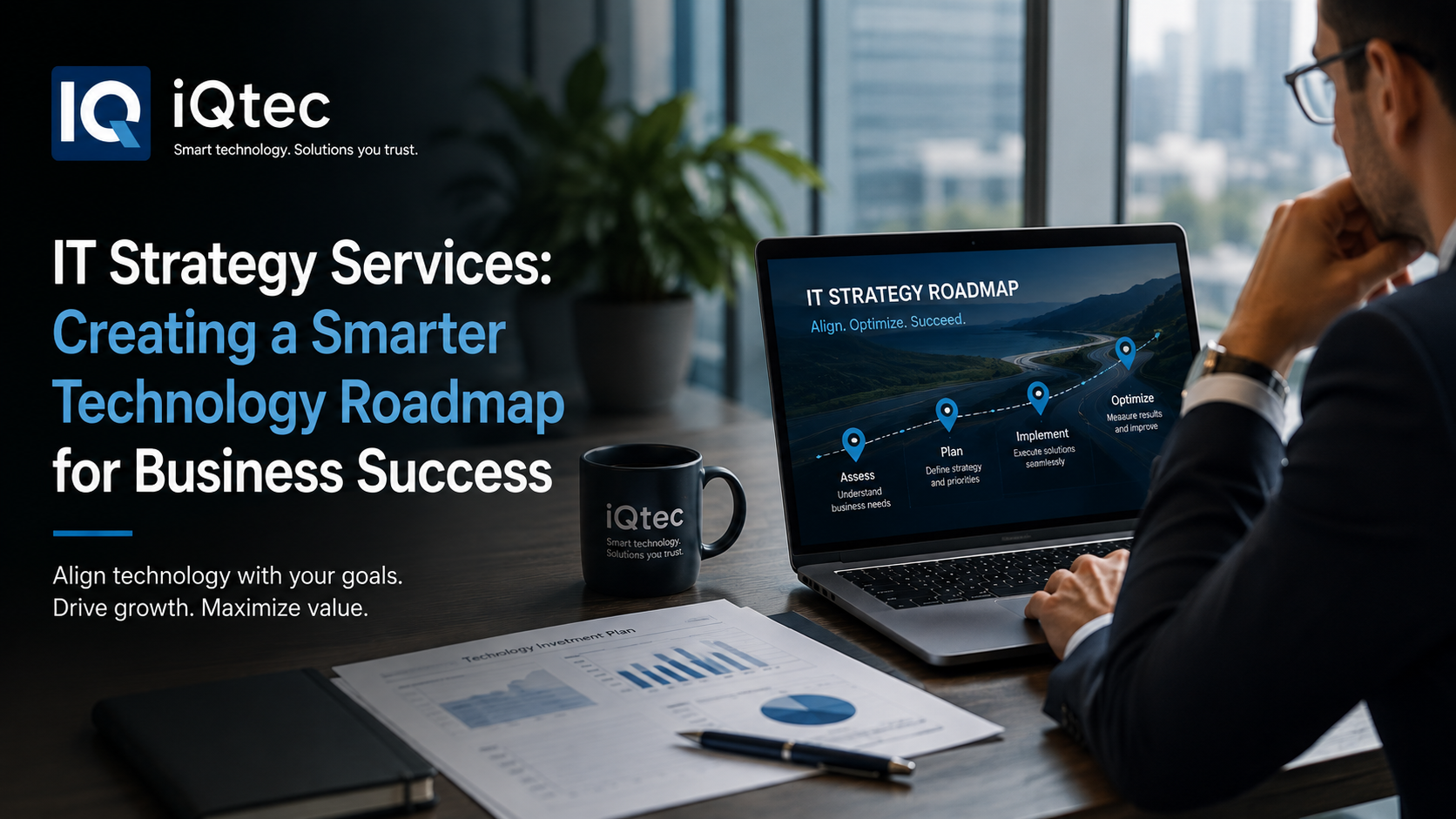
Building a Technology Roadmap
A roadmap turns strategic objectives into practical initiatives. Projects can be organized according to:
- Business impact
- Urgency
- Risk
- Cost
- Complexity
- Available resources
- Expected return
This makes it easier for management to understand which initiatives should happen first.
Integrating Cybersecurity
Security should be considered throughout the technology strategy. Identity management, endpoint security, data protection, backups, access controls, compliance, and risk management should all form part of the broader technology roadmap.
Developing a Cloud Approach
Cloud services can improve flexibility and scalability, but businesses need to understand where cloud adoption makes sense. A cloud strategy can help determine which systems should move, which should remain on-premises, and how cloud environments should be secured and managed.
When Is It Time to Revisit Your IT Strategy?
Certain situations can indicate that a business needs a more structured technology direction.
You may need to review your strategy if:
- IT problems are frequently handled reactively.
- Technology costs continue to increase.
- Employees rely on too many disconnected applications.
- Legacy systems are affecting productivity.
- Cybersecurity concerns are increasing.
- The company is experiencing rapid growth.
- New cloud platforms are being introduced without a defined plan.
- Management is unsure which IT projects deserve priority.
- Existing technology does not support future business objectives.
Building a Roadmap That Prioritizes What Matters
One of the biggest mistakes businesses can make is attempting to complete every technology project simultaneously.
A better approach is to divide initiatives into manageable stages.
Now
Focus on urgent business issues, security risks, system reliability, and critical operational improvements.
Next
Prioritize projects that improve efficiency, productivity, scalability, and employee experience.
Future
Consider longer-term initiatives such as automation, advanced analytics, AI, digital transformation, and emerging technologies.
This Now → Next → Future approach can make technology planning easier to manage while keeping investments aligned with business priorities.
IT Strategy and IT Planning: What's the Difference?
IT planning and IT strategy are closely connected, but they are not the same.
IT planning focuses on specific projects, resources, budgets, activities, and timelines.
IT strategy establishes the broader direction. It explains why certain technology investments are important and how they contribute to business objectives.
In simple terms:
Strategy = Where are we going and why?
Planning = What do we need to do and when?
When planning is supported by a strong strategy, technology projects are more likely to deliver meaningful business outcomes.
How iQtec Can Help Businesses Build a Technology Roadmap
iQtec works with Australian businesses across technology consulting, cybersecurity, cloud, IT management, and related technology services.
Its IT strategy services can help organizations evaluate their current technology environment, identify gaps, establish priorities, and develop a practical roadmap for future technology investments.
The focus should be on finding technology solutions that make sense for the business rather than implementing technology simply because it is available.
A well-developed strategy considers business goals, security, scalability, operational needs, budget, and long-term growth.
A Simple Framework for Developing an IT Strategy
Businesses can start by answering five important questions:
1. What Do We Have Today?
Review existing systems, infrastructure, applications, cloud platforms, security controls, and processes.
2. What Does the Business Want to Achieve?
Identify short-term and long-term business objectives.
3. What Technology Gaps Exist?
Determine what is preventing the organization from achieving those objectives.
4. What Should Be Prioritized?
Rank projects according to business value, urgency, risk, cost, and available resources.
5. How Will Success Be Measured?
Establish practical measures to determine whether technology investments are improving productivity, security, efficiency, customer experience, or other business outcomes.
Final Thoughts
Technology should support business growth rather than become another source of complexity. IT strategy services provide businesses with a structured way to evaluate their technology environment, establish priorities, manage risks, and plan future investments.
With a clear technology roadmap, organizations can move away from short-term, reactive decisions and build an IT environment that is more secure, scalable, efficient, and aligned with their long-term objectives.
The most effective IT strategy is not about having the most technology. It is about having the right technology, at the right time, for the right business reasons.
FAQs
What are IT strategy services?
IT strategy services help businesses evaluate their current technology environment and create a roadmap that aligns IT capabilities and investments with business goals.
Why should a business have an IT strategy?
An IT strategy provides direction for technology investments, helps prioritize projects, improves cost management, and identifies potential technology and security risks.
How often should an IT strategy be updated?
Businesses should review their IT strategy regularly and whenever major changes occur, such as expansion, acquisitions, significant technology investments, or changes in security requirements.
Are IT strategy services useful for small businesses?
Yes. A clear strategy can help small businesses make better use of limited IT budgets, prioritize essential improvements, and avoid unnecessary technology investments.
Does an IT strategy include cybersecurity?
Yes. Cybersecurity should be integrated into the overall IT strategy because security risks can directly affect operations, finances, compliance, and business continuity.
What is an IT technology roadmap?
An IT roadmap is a prioritized plan that outlines technology initiatives, improvements, and investments over a specific period to help an organization achieve its business objectives.