Cybersecurity has become a core business requirement for Australian organisations. As businesses rely more heavily on cloud platforms, remote access, connected devices, digital communication, and online applications, protecting systems and data requires more than occasional security checks.
The Australian cybersecurity market includes large technology companies, specialist security providers, managed service providers, and IT partners that combine cybersecurity with broader technology management. Each provider may approach security differently, with capabilities ranging from security assessments and compliance through to managed detection, incident response, cloud security, governance, and ongoing security management.
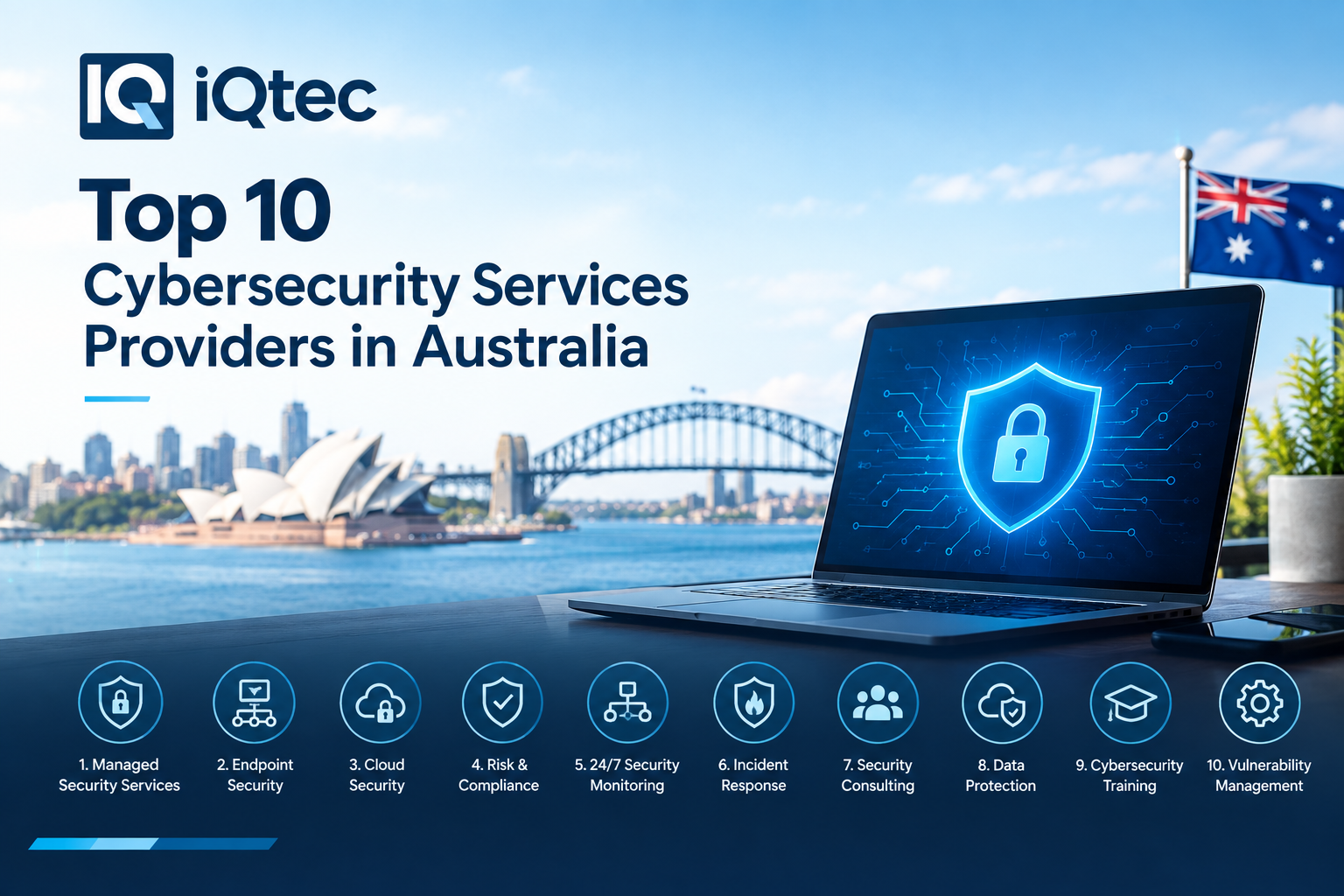
This guide looks at 10 Cybersecurity Services providers in Australia and the areas businesses can consider when evaluating their capabilities. The list is presented for comparison rather than as a ranking.
1. iQtec
iQtec combines cybersecurity with managed IT, cloud, networking, consulting, and technology strategy. Its cybersecurity approach focuses on assessing an organisation’s current security position, managing security controls, monitoring risks, and improving security maturity over time.
Its cybersecurity services include cybersecurity audits, governance, risk and compliance support, Essential Eight alignment, and SMB1001 alignment. This makes the service relevant to businesses that want security to work alongside their wider IT environment rather than operate as a completely separate function.
iQtec also supports organisations with managed IT and cloud services, allowing security considerations to be integrated into everyday technology management.
2. CyberCX
CyberCX is an Australian cybersecurity-focused organisation offering a broad range of security services. Its capabilities cover areas such as cyber advisory, testing, managed security, incident response, identity, cloud security, and security operations.
Its specialist cybersecurity focus can be relevant for organisations looking for dedicated security expertise across different stages of the cybersecurity lifecycle.
Businesses considering a specialist provider can examine whether the provider’s capabilities align with their specific requirements, particularly when security needs extend beyond basic IT protection.
3. Telstra Purple
Telstra Purple brings together technology consulting and professional services across areas including cybersecurity, cloud, networking, and digital transformation.
Its position within a broader telecommunications and technology environment can be relevant to organisations that want security considered alongside connectivity, cloud infrastructure, and enterprise technology.
For businesses with complex environments, an important consideration is how cybersecurity services connect with existing networks, cloud platforms, communication systems, and business applications.
4. Deloitte Australia
Deloitte Australia provides cybersecurity and risk-related services as part of its broader consulting and professional services capabilities.
Its cybersecurity work can involve areas such as cyber strategy, risk management, governance, technology security, resilience, and incident-related support.
This type of model can be relevant to organisations that require cybersecurity alongside broader business, regulatory, risk, or transformation consulting.
Businesses evaluating a large professional services provider may want to identify which services are most relevant to their operational requirements and whether they need strategic advisory, technical implementation, managed security, or a combination.
5. Accenture Australia
Accenture provides cybersecurity services alongside cloud, technology, consulting, and digital transformation capabilities.
Its security capabilities can support organisations dealing with complex technology environments, transformation programs, cloud adoption, identity requirements, and security operations.
For larger organisations, cybersecurity may need to be considered across multiple systems and business functions. Providers with broad technology capabilities can therefore be evaluated based on how effectively they connect security with wider transformation initiatives.
6. Datacom
Datacom operates across technology services including managed services, cloud, cybersecurity, and digital solutions.
Its cybersecurity capabilities are relevant to organisations looking for security services within a broader managed technology environment.
For businesses considering a provider such as Datacom, it can be useful to examine the relationship between cybersecurity, managed infrastructure, cloud services, support, and the organisation’s wider IT operating model.
This is particularly important where security responsibilities are distributed across internal IT teams and external technology providers.
7. NTT DATA Australia
NTT DATA provides technology and cybersecurity capabilities as part of its broader digital transformation and IT services portfolio.
Its technology focus spans areas such as cloud, applications, infrastructure, data, consulting, and cybersecurity.
Organisations with complex digital environments may consider providers with capabilities across multiple technology areas because cybersecurity increasingly needs to be integrated with applications, infrastructure, cloud platforms, and data management.
The appropriate service model will depend on the organisation’s security maturity, technology environment, regulatory requirements, and internal capabilities.
8. Fujitsu Australia
Fujitsu Australia provides technology and cybersecurity services across enterprise and government environments.
Its broader technology capabilities include infrastructure, cloud, digital transformation, and security.
Cybersecurity in larger environments often involves more than protecting individual devices. Organisations may need to consider identity, infrastructure, applications, data, cloud systems, governance, and operational resilience together.
For this reason, businesses assessing providers should consider whether a cybersecurity service can operate effectively across their complete technology environment.
9. DXC Technology Australia
DXC Technology provides enterprise technology services that include cybersecurity, managed services, cloud, infrastructure, and digital transformation.
Its cybersecurity capabilities can be considered by organisations that require security within a broader enterprise technology environment.
Large organisations often have multiple systems, locations, applications, and technology platforms. A provider’s ability to integrate security with infrastructure and managed services can therefore be an important consideration.
Businesses should assess the specific cybersecurity services included in a proposed engagement rather than assuming that every provider’s managed security model is the same.
10. KPMG Australia
KPMG Australia provides cybersecurity, risk, governance, and technology-related consulting services.
Its cybersecurity capabilities can be relevant to organisations dealing with governance requirements, cyber risk, regulatory considerations, technology risk, and broader business transformation.
This type of approach can be particularly relevant when cybersecurity decisions involve business risk and governance rather than only technical controls.
Organisations should identify whether they need advisory services, technical security implementation, managed security, compliance assistance, or a combination of these areas.
Why Cybersecurity Services Need a Business-Focused Approach
Choosing cybersecurity services should not start with technology alone.
A business first needs to understand what it is protecting.
Critical information, customer data, intellectual property, financial systems, employee accounts, cloud applications, and operational systems can all have different levels of importance.
A cybersecurity strategy should therefore consider business impact as well as technical risk.
This is why modern cybersecurity services Australia businesses use increasingly involve assessment, governance, monitoring, compliance, and continuous improvement rather than simply installing security tools.
What Should Businesses Look for in a Cybersecurity Provider?
The right requirements vary between organisations, but several areas deserve attention.
Security Assessment
A provider should be able to understand the organisation’s current security position and identify meaningful gaps. A cybersecurity audit can provide a structured starting point for improvement.
Ongoing Monitoring
Security risks can change after the initial assessment. Businesses should understand what monitoring and ongoing oversight are included in the service.
Compliance and Governance
Australian organisations may have industry, contractual, regulatory, or internal security requirements. Providers should be able to explain how their services support relevant obligations.
Essential Eight Knowledge
The Essential Eight provides a recognised framework for improving cybersecurity maturity in Australian organisations. iQtec, for example, provides Essential Eight alignment services that assess current maturity, prioritise controls, and support implementation.
Incident Response
Businesses should understand what happens if a serious security incident occurs. Response responsibilities, escalation processes, communication, and recovery should be clearly defined.
Integration With IT
Cybersecurity should not operate independently from everyday IT. Device management, cloud administration, user access, patching, backups, and network management can all influence security.
This integrated approach is one of the areas where iQtec connects cybersecurity with managed IT and cloud services.
Cybersecurity for Small and Mid-Sized Businesses
Cybersecurity is not only an enterprise concern.
Small and mid-sized businesses can face significant risks while often having fewer internal resources dedicated to security. A large security department may not be practical for every organisation, making managed cybersecurity services an alternative approach.
iQtec specifically describes its managed cybersecurity services as being designed to support small and mid-sized businesses without unnecessary enterprise-level complexity.
For these businesses, a practical security program can focus on the controls that address their actual risk rather than implementing technology simply because it is available.
Managed Cybersecurity vs One-Time Security Assessments
A security assessment can identify weaknesses, but cybersecurity does not end when the report is delivered.
A business environment changes constantly. Employees join and leave, applications are introduced, devices are replaced, cloud configurations change, and new threats emerge.
Managed cybersecurity takes a more continuous approach.
iQtec describes its model around assessing the current position, managing and monitoring security controls, responding to emerging issues, and improving security maturity over time.
For businesses comparing providers, understanding whether the service is primarily advisory, project-based, or ongoing can help establish what type of support they are actually receiving.
How iQtec Approaches Cybersecurity
iQtec positions cybersecurity as part of a wider technology environment rather than a standalone product.
Its cybersecurity services include audits, governance, risk and compliance, Essential Eight alignment, and SMB1001 alignment. The organisation also provides managed IT, cloud, networking, consulting, AI, and procurement services.
This connected approach can be useful for businesses where cybersecurity overlaps with everyday IT operations.
For example, improving security may involve changes to user access, devices, cloud platforms, network infrastructure, backup processes, or employee practices. Managing these areas together can make security improvements easier to coordinate.
How to Compare Cybersecurity Providers
Businesses should avoid selecting a cybersecurity provider based solely on the number of services listed.
Instead, consider the organisation’s current security maturity, internal IT resources, business size, industry requirements, cloud environment, compliance obligations, and future growth plans.
It is also worth asking:
- What security risks will the provider actually manage?
- Is monitoring included?
- How are security incidents escalated?
- Does the provider support Essential Eight requirements?
- Can the service work alongside an internal IT team?
- How frequently are security controls reviewed?
- What reporting will business leaders receive?
- Can the cybersecurity service scale as the business grows?
These questions can help turn a broad provider comparison into a more practical evaluation.
FAQs
What are cybersecurity services?
Cybersecurity services help organisations protect systems, data, users, applications, and networks from security threats. Depending on the provider, services may include audits, monitoring, compliance, governance, security management, incident response, and security improvement.
Why do Australian businesses need cybersecurity services?
Businesses increasingly rely on connected systems and digital platforms. Cybersecurity services can help organisations identify risks, strengthen controls, support compliance, and improve resilience against security incidents.
What is the Essential Eight?
The Essential Eight is an Australian cybersecurity framework focused on practical controls designed to reduce the impact of common cyber threats. Businesses can use it as a framework for improving security maturity.
Are managed cybersecurity services suitable for small businesses?
Yes. Managed cybersecurity can provide access to specialist expertise and ongoing security management without requiring a business to build a large internal cybersecurity function.
What is the difference between cybersecurity and IT support?
IT support focuses primarily on keeping technology functioning and helping users resolve technical problems. Cybersecurity focuses specifically on protecting systems, data, users, and infrastructure from security threats. The two functions increasingly overlap.
Can cybersecurity services work with an internal IT team?
Yes. External cybersecurity providers can complement internal IT teams by providing specialist expertise, security assessments, monitoring, compliance support, or independent oversight.
Conclusion
Australia’s cybersecurity landscape includes specialist cybersecurity organisations, major technology companies, consulting firms, and managed IT providers. The 10 providers discussed above demonstrate the range of approaches available to Australian businesses.
The most useful comparison is not simply the size of a provider or the number of services it offers. Businesses should consider their actual security requirements, internal capabilities, compliance obligations, technology environment, and future plans.
For organisations seeking an integrated approach, iQtec combines cybersecurity with managed IT, cloud, networking, consulting, and strategic technology services. Its cybersecurity offering focuses on assessment, ongoing management, compliance support, and continuous improvement.
Ultimately, effective cybersecurity services Australia businesses rely on should help create a security environment that is practical, measurable, continuously managed, and capable of evolving as the organisation grows.